
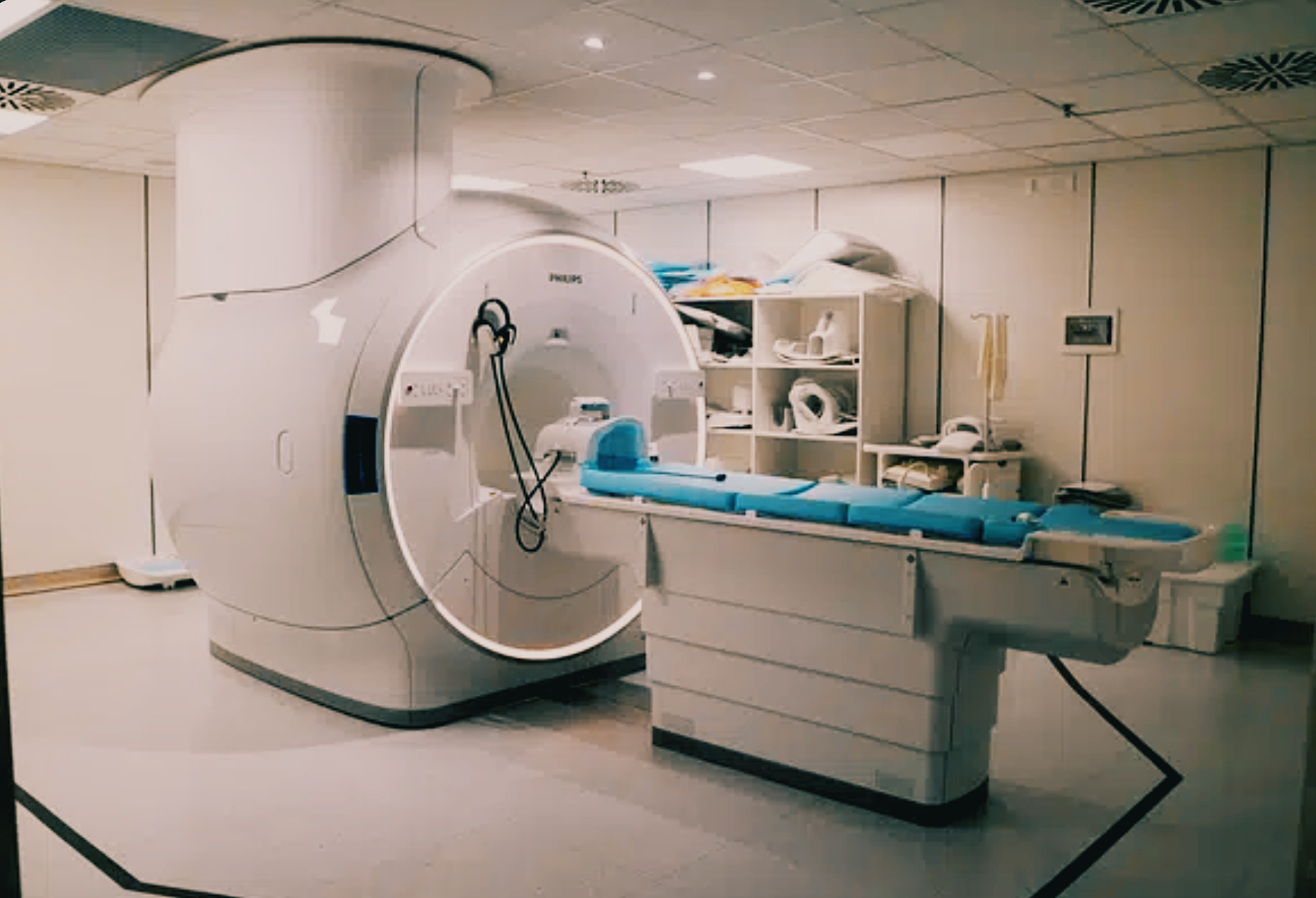
How strange these rooms we do our medical self-care in are!
Recently I had to have an MRI. What an unpleasant experience! I was at Cooley Dickinson's MRI Center for what promised to be the first of annual enhanced breast cancer screenings due to family history.
There I was, lying face down on the table, bare breasts hanging down through an opening, slid back feet first into the maw of the machine. My right arm was stretched forward on the table in front of my head. My left, with its sensitive shoulder, was awkwardly propped on a series of towels along my side, next to the various tubes and gear surrounding me. I was trying to be calm and compliant, although I hate these things, and I was already pretty uncomfortable.
The technician spoke in my ear via the provided headphones, announcing the first in the series of tests. This one was just a calibration and would last about 30 seconds.
And then the sound started. It was deafening! And weird! Whirrs and thumps and clangs. BRR-CHUNG! BRR-CHUNG! BRR-CHUNG! It sounded like something flying around behind me throwing off laser bombs in some urban hellscape. My body instantly flooded with adrenaline.
Peter Levine, the founder of Somatic Experiencing therapy, has taught us that the body often experiences medical procedures as traumatic, even ones that we've chosen for good, positive self-care reasons. And of course! We go into a strange, usually cold room, filled with shiny, hard surfaces, take off our clothes, and then strangers immobilize our bodies and subject them to invasive, uncomfortable, or even painful interventions.
Of course the body flags this as a threat! Mine certainly just had, and it was readying me to jump and flee. But I was supposed lie perfectly still through this for twenty-five more minutes.
Lying there on that table, my guts suddenly turning over and my limbs filling with the icy tingle of mobilization, I had a choice. I could suffer through this miserably, gritting my teeth and resenting the world the entire time, and then feel tense, put upon, and horrible for the rest of the day, or I could put my nervous system training to work and use the tools I have to shift my state. I could do that, couldn't I? Could I?
To my astonishment, this actually worked. My experience of the procedure shifted. I still found it uncomfortable, unpleasant, and bizarrely loud, and I was eager the entire time for it to be over. But I also felt – not just thought, but felt – that I was here on purpose, for my own good reasons. This was something I had chosen, and was continuing to choose, not something that was being done to me.
In biodynamics, we call this our window of presence, that state where, whatever is happening, we feel like we have agency, resources, and the ability to respond from choice.
So I wanted to share with you what worked. It was a combination of three things: using my breath, asking for – and receiving – help, and, crucially I think, how I spoke to myself.
First, the breath. Our breath is one of the rare autonomic processes that we can also put under our conscious control, so it's a powerful place to dialogue with our nervous system. The prominence of breathing and chanting techniques in the world's wisdom traditions attests to this power.
The technique that works the most reliably for me is to slow my breathing to about 6 breaths per minute, breathing in to a count of 5 and then out for 5. Because our breath naturally slows when our body settles down into rest-and-digest mode, slowing our breathing can communicate to our bodies that it's now safe enough to rest.
Throughout the rest of the procedure I breathed slowly and deliberately – although not too deeply, because I messed up one of the scans with too much movement, and we had to repeat it. Beyond the power of the breath, I think just being able to choose to do something to influence my experience of the process gave me a sense of agency and control over what was happening.
But breathing by itself often isn't enough. If we're really in an anxiety spiral, with a lot of tension in the chest, focusing on the breath can feel uncomfortable or even worsen our sense of being trapped in our own skin. So the second key thing I did was ask for help.
At this point I have to say that the staff at Cooley Dickinson were excellent! Professional, kind, and compassionate, they had made me feel safe and in good hands from the moment I walked in. They had carefully explained everything that would be happening, and they had really impressed me by offering to look up the music of my choice on Spotify and play it through the headphones.
From my craniosacral therapy training, I know that social connection – feeling connected to and supported by people that we feel safe enough with – is a shortcut to settling the nervous system and getting back into the window of presence. So as soon as I decided to really try to shift how I was experiencing this process, I pushed the button they had placed in my hand to indicate that I needed help.
During setup, they had offered me earplugs to put under the headphones. I had turned this down because it didn't make any sense to me – how could I hear what the headphones were playing if I had earplugs inside them? But now I saw I needed more protection from the sound, and I asked for them. I also asked for and received a little adjustment to the padding under my arm, which was sliding out of its improvised position. That little bit of helpful interaction told my body that I was in a safe place, with caring people, undergoing something I had influence over. And that made a huge difference.
The third, more subtle thing was how I spoke to myself. This isn't something I did consciously, but I think it provided the foundation for my other two strategies. From that moment of making the choice to approach this procedure differently than previous ones, I somehow confidently told myself, "I have all this understanding of my nervous system. I know this stuff. I can do this."
I think this was not so much a technique, but equal parts inner knowing and fierce decision. Years of learning about the nervous system and the experience of watching my own spike out of my window of presence and settle back in, over and over, has led me to trust that it will return, however long it may take. But I also just made a split-second decision to tell myself it would work, and it actually did!
Re-settled with my earplugs, my arm slightly more comfortable, and my breath consciously slow, the adrenaline ebbed, the procedure went forward, and I walked out twenty-five minutes later into the rest of my day without a tension headache and without hating the world.
This fall and winter, I'm offering a two-part webinar series with River Valley Co-op where I'll share the nervous system strategies that have worked for me and help participants find ones that work for them. On Thursday, November 5, in Nervous System First Aid, we'll learn about the autonomic nervous system, how it scans for and responds to threats, and how we can use strategies like breathing, focusing on our senses and our environment, and connecting with the people around us to quickly shift our system in moments of stress. On Thursday, January 7, in Nervous System Wellness, we'll explore strategies for getting familiar with your nervous system's ups and downs and shifting your baseline over time to a more comfortable and responsive place.
I'm really excited about teaching these webinars, because this knowledge has made such a difference in my own life. I hope you'll join me.
Try this: Take a few slow breaths
Give this a try for the first time in low stakes situation, like when consciously taking a break from your screen, or on climbing into bed at the end of the day. Let your breathing slow easily. Don't work too hard at it. Just see what's available.
Then try counting to 5 on the in-breath and then to 5 on the out-breath. Do this just a few times, maybe for 6 or 8 breaths, and then see how you feel. You may feel a palpable sense of slowing, settling, or arriving more fully in your body.
Studies have shown that breathing at a rate of 5-6 times per minute stimulates the vagus nerve and produces a relaxation response in the body's systems. With breathing practices, less tends to be more, so try this for only 1 to 2 minutes at a time. With regular practice, this might become a go-to resource for you when you need it.